What's Actually in a Disposable Nappy?
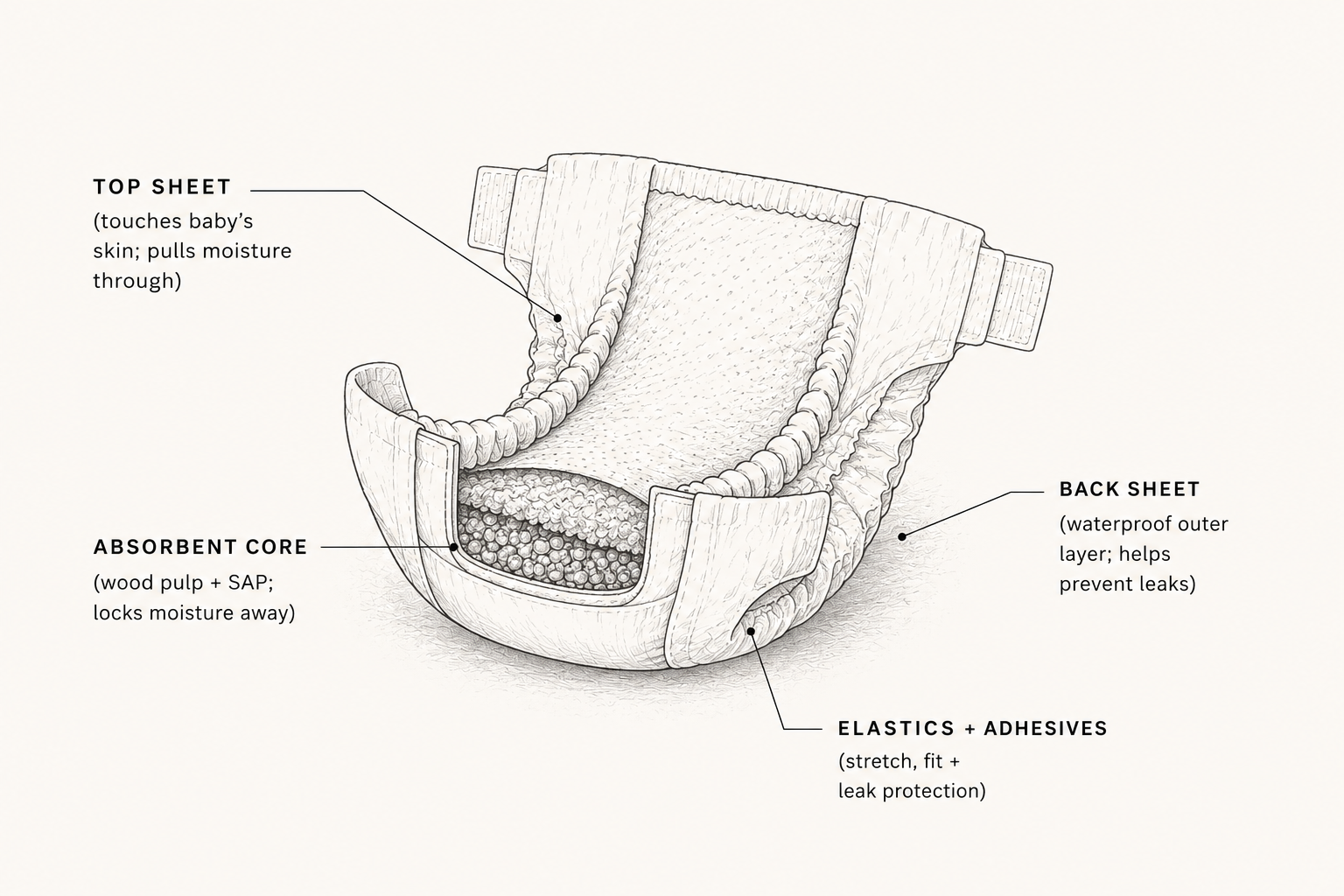
Before you get pulled into “bamboo,” “plant-based,” or “non-toxic” marketing, it helps to know what a disposable nappy actually is.
Because while packaging gets creative, most disposable nappies are built in roughly the same way. The differences tend to come down to ingredient choices, transparency, and performance.
THE CLAIMS
BAMBOO
This is one of the most misunderstood claims in baby products.
A “bamboo nappy” does not mean the whole nappy is bamboo. It doesn’t mean plastic-free and it doesn’t automatically mean cleaner.
Usually, it means some component includes bamboo-derived fibre—often processed into rayon or viscose—while the rest of the nappy still looks much like every other disposable.
Useful context, not a deciding factor.
PLANT-BASED
This sounds bigger than it usually is. In practice, “plant-based” often means one material, or part of one material, is derived from plant sources.
It does not mean the nappy is free from synthetic materials. This isn’t necessarily misleading—but it’s often incomplete.
CHLORINE-FREE
This one matters more.
Disposable nappies typically use wood pulp in the absorbent core, and that pulp is often bleached during manufacturing.
Some brands use elemental chlorine-free (ECF) processing. Others use totally chlorine-free (TCF) methods.
Parents don’t need a chemistry degree here. The practical takeaway: if a brand is transparent about chlorine processing, that’s generally a positive signal.
HYPOALLERGENIC
Sounds reassuring.
Also vague.
There’s no universal parent-friendly definition that makes this claim especially useful on its own.
It’s one of those terms that sounds more definitive than it is.
DERMATOLOGIST TESTED
This gets a lot of airtime.
But “tested” doesn’t tell you much without context. Tested how? Compared with what? Against which ingredients? It’s not meaningless. It’s just not the gold star many parents assume.
THE CLEAN BAR
At GoodCall, we care less about earthy branding and more about what’s actually disclosed.
For disposable nappies, we prioritise:
✓ No added fragrance ✓ No lotions sitting against skin ✓ Chlorine transparency ✓ No obvious PFAS / PVC / phthalates ✓ Clear material disclosure ✓ Strong absorbency
Because a “clean” nappy that leaks constantly is still a problem.
THE QUESTIONS
ARE DISPOSABLE NAPPIES TOXIC?
Most mainstream nappies sold in Australia meet regulatory safety standards. That doesn’t mean every brand makes equally thoughtful ingredient choices, or explains them clearly.
Our view: “toxic” is rarely a useful category here. Material transparency is.
IS SAP SAFE?
SAP tends to trigger concern because “polymer” sounds industrial. But SAP is what allows disposable nappies to absorb and hold liquid efficiently. Without it, nappies would be bulkier, leak more, and leave babies sitting in moisture for longer—which isn’t exactly better for skin.
For most parents, SAP itself isn’t the big issue. The bigger question is the overall product design and what else is included.
WHAT CAUSES NAPPY RASH?
Usually not one dramatic hidden ingredient. More commonly:
- prolonged moisture
- infrequent changes
- friction
- poor fit
- sensitivity to fragrance or lotions
- illness / diarrhea
Sometimes the answer is simply a better-performing nappy.
ARE BAMBOO NAPPIES BETTER?
Not automatically. Some are excellent. Some are mostly clever branding. You have to look past the front of the pack.
CLOTH OR DISPOSABLE?
Different trade-offs. Cloth reduces disposable waste. Disposable usually wins on convenience, overnight absorbency, travel and childcare practicality.
For most families, this is logistics—not ideology.
Ready for the shortlist?